Back to the gallery

Field Guide

The Ball Python Care Sheet

Everything a new owner needs to keep a ball python healthy — enclosure, temps, humidity, feeding, shedding, handling, health — written the way we keep our own animals. Every snake that leaves this facility is raised under this exact standard.

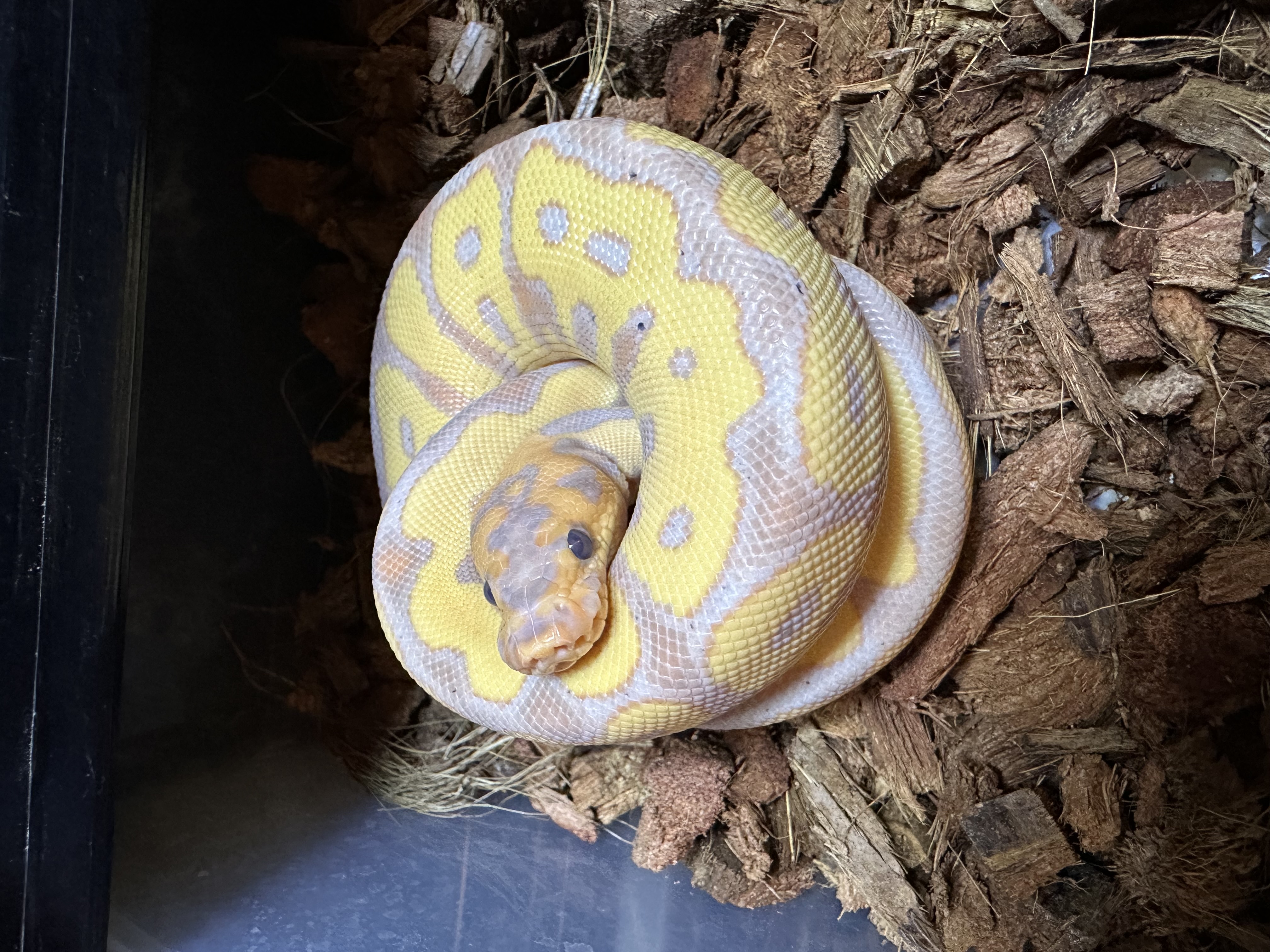
A Green Line Morphs ball python coiled in a resting position on wood-chip substrate inside a secure enclosure — photographed by Jay
88–92°F Warm side
78–80°F Cool side
60–70% Humidity
5–7 · 10–14 Feeding · hatchling · adult days

Enclosure

Juveniles do fine in a 10–20 gallon (roughly 20–30″ long) while they grow — or go straight into an adult-size enclosure packed with clutter. A small snake in a huge, bare box feels exposed, not enriched.

Adults need a 40-gallon breeder (36″ long) as the working minimum; the gold standard is a 4×2×2 (120-gallon). Ball pythons are terrestrial — floor space matters, height doesn't. Front-opening PVC enclosures hold heat and humidity and make handling far easier.

Whatever you choose, the lid must be secure — clips, locks, or a heavy top. Ball pythons are escape artists. Open-top mesh tanks kill humidity and bleed heat; if you use a glass tank with a screen lid, plan to manage humidity (see Humidity).

Juvenile: 10–20 gal Adult: 40 gal min · 4×2×2 Secure lid, always

Temperatures

Build a temperature gradient across the enclosure: a warm side at 88–92°F and a cool side at 78–80°F. The warm hide can touch the low 90s; nothing in the enclosure should ever exceed 95°F.

Measure with digital thermometers at snake level — the floor where the snake actually lives — or a temperature gun. Analog stick-on thermometers are notoriously inaccurate. One probe on each end.

Verify the gradient daily for the first week, then weekly. A snake that's too cold can't digest; one that's too hot will burn itself trying to escape the floor.

Warm side 88–92°F Cool side 78–80°F Never above 95°F Measure at snake level

Humidity

Ball pythons need 60–70% humidity day to day, bumped to 70–80% when they're in shed. Measure it with a digital hygrometer — guesswork is how sheds go bad.

Raise it with three tools, in this order: a large water bowl (surface area = evaporation), a moisture-retentive substrate (coco husk or cypress), and misting as needed. In a glass tank, most of your humidity escapes through the screen lid — covering part of it with foil or acrylic is often the single biggest fix.

Steady 60–70% is the goal. Constantly wet substrate is just as wrong as dry air — it breeds scale rot and blisters.

60–70% daily 70–80% in shed Digital hygrometer

Substrate

Safe and recommended: coconut husk/coir, cypress mulch, orchid bark — all hold humidity well. Aspen is safe but dry, so it's a second choice for a species that needs moisture. Plain paper towel is ideal for quarantine and new arrivals: zero dust, no hiding spots for mites, and easy to read waste.

Never cedar or pine. The aromatic oils in softwoods are toxic to reptiles. Also avoid sand and calci-sand — ingestion risk.

Spot-clean waste as soon as you see it, and replace the full substrate every 4–8 weeks — sooner if it stays damp.

Coco husk · cypress · orchid bark No cedar · no pine Paper towel for quarantine

Hides

Give your snake two identical hides — one on the warm side, one on the cool side. "Identical" is the point: if one hide is bigger, brighter, or more exposed, the snake has to choose between safety and temperature — and it will often pick safety and stop thermoregulating.

A correct hide is snug — the snake should touch three sides and the top when coiled. Bigger is not better. Half-logs, cork rounds, and commercial hides all work; the shape matters less than the fit.

Add clutter — fake plants, branches, leaf litter — so the snake can travel between hides without crossing open floor. A hidden ball python is a calm ball python.

Two identical hides One warm · one cool Snug fit

Heating

Warm the warm side with an under-tank heater or heat tape under the warm hide, or an overhead source (ceramic heat emitter or deep heat projector) mounted safely above — or both for a larger enclosure.

Every heat source runs through a thermostat. No exceptions. The thermostat probe sits between the heater and the enclosure floor, so it regulates the surface your snake actually touches. An unregulated mat can hit 120°F+ and burn a snake that can't escape it.

Never use heat rocks. They heat unevenly and have injured and killed reptiles for decades. Run the setup for 24–48 hours before the snake moves in, and verify the warm-hide floor with a temperature gun — not a guess.

Thermostat on everything UTH · heat tape · CHE · DHP No heat rocks, ever

Water

A heavy bowl large enough for the snake to fully coil in — ball pythons soak, especially before a shed. A wide, low, ceramic or plastic bowl that can't tip is ideal.

Fresh, clean water daily. Wash the bowl with hot water and dish soap, rinse thoroughly, refill. A stale bowl is a bacterial hotel.

Placement is a tool: on the warm side the bowl boosts humidity; on the cool side it stays cooler. Either is fine — what matters is that it's always full, always clean, always there.

Fresh water daily Big enough to soak in Heavy, tip-proof bowl

Feeding

Prey size should be roughly the widest part of the snake's body — hatchlings can take a slightly larger meal, but too big causes regurgitation and too small underfeeds. Frozen-thawed rodents are the standard: no live prey, which can fight back and injure your snake.

Schedules: hatchlings every 5–7 days, juveniles every 7–10, adults every 10–14. Watch body condition and adjust — a healthy adult keeps a rounded, not square, cross-section.

Thaw in the fridge or cold water, then warm to body temperature with warm water — never microwave — and offer with tongs. Don't handle for 24–48 hours after feeding. A snake that refuses food: check temperatures first, then stress, then health.

Hatchlings 5–7 days Juveniles 7–10 days Adults 10–14 days Prey ≈ widest part of body

Shedding

When the eyes go cloudy and milky — "blue" — bump humidity to 70–80%. The eyes clear again, and the shed follows a few days later. A healthy shed comes off in one continuous piece, eye caps included.

If part of the shed sticks: add a humid hide (a hide packed with damp sphagnum moss) or a shallow lukewarm soak for 15–20 minutes, and let the snake rub it off itself. Never peel — pulling stuck shed can tear scales and damage eyes.

Repeated bad sheds are almost always a humidity problem. Fix the enclosure, not the snake.

70–80% humidity in shed One-piece shed = healthy Never peel stuck shed

Handling

Keep sessions short, gentle, and consistent — 10–15 minutes, a few times a week. Support the body with both hands and let the snake move through them. Never grab, squeeze, or dangle.

Skip handling for 24–48 hours after feeding — a handled snake can regurgitate a meal it's trying to digest. And skip handling during shed, especially in blue, when vision is compromised and the snake is more defensive than usual.

Learn the stress signals: tight balling, hissing, striking, musking, tail rattling, frantic escape attempts. All of them mean end the session and put the snake back. A calm, regularly handled ball python is a pleasure — but calm comes from a correct setup and patient handling, not from forcing it.

10–15 minute sessions Wait 24–48 hours after feeding Respect stress signals

Health Checks

Run a quick check once a week: clear bright eyes (except in shed), a clean vent, smooth unscarred belly, firm rounded body — no visible spine, no kinks, no stuck eye caps.

Watch for respiratory infection: wheezing, bubbles at the mouth or nose, open-mouth breathing, excess saliva, head held up oddly. Any of these means a vet, quickly.

Other red flags: mites (tiny black specks that move, snake soaking constantly), burns, prolonged refusal to eat, lethargy, regurgitation. And find a reptile-experienced vet before you need one — most ball python problems are husbandry problems, and they're preventable.

Weekly check Clean vent · clear eyes Vet for RI signs

Common Mistakes

These are the mistakes we see most often — and every one of them is preventable with the sheet above.

Overfeeding

Too much too often shortens a snake's life. Feed on schedule, by size.

Wrong temperatures

Too cold and food rots in the stomach. Too hot and you cook the snake.

No thermostat

The #1 cause of burns. If your heat source isn't regulated, it isn't set up yet.

Handling in shed or after feeding

Stressed snakes refuse meals, regurgitate, and shed badly. Give them space.

Unsecured enclosure

Ball pythons are escape artists. Secure the lid before it matters — not after.

Screen-top tank, no humidity plan

You'll fight stuck sheds and respiratory issues forever. Fix the lid, fix the shed.

Ready to bring one home?

Every Green Line Morphs animal ships documented, quarantine-cleared, and eating — and this sheet is the standard we expect you to keep it at. Questions? We answer every DM.